
How AI Phone Answering Works for HVAC Companies
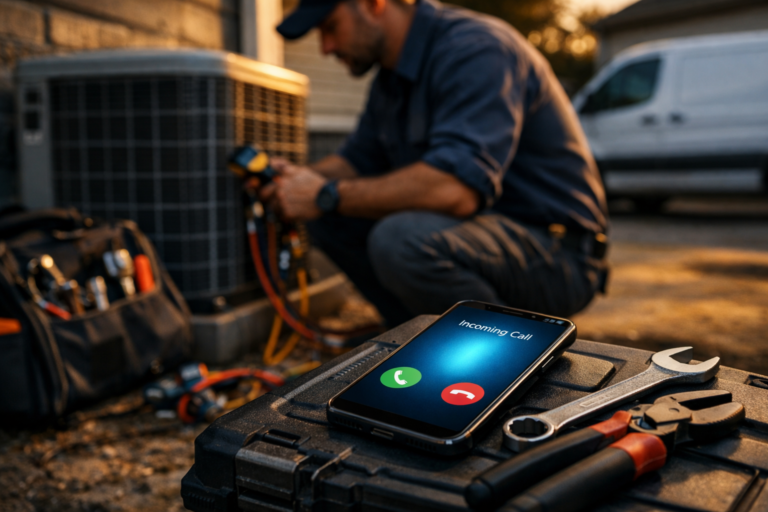
You’re on a roof in July, sweat dripping, replacing a condenser unit. Your phone buzzes in your pocket. You ignore it—you’re in the middle of tightening down a refrigerant line. By the time you climb down and check your phone, the caller already moved on to the next HVAC company in their search results. That missed call just cost you a $4,000 install.
This happens every single day in HVAC businesses. You’re either on a ladder, under a house, or elbow-deep in ductwork when the phone rings. You can’t answer. Your competitor does. They get the job.
Missing calls doesn’t just mean losing one job—it means losing recurring maintenance contracts, referrals, and the chance to build your reputation as the HVAC company that actually picks up. The worst part? Most of these calls come in after hours, on weekends, or during your busiest service windows. Exactly when you need the work most, but can’t physically be in two places at once.
Hiring a full-time answering service or office staff sounds like the fix, but the math rarely works for a small shop. You’re paying someone to sit around between calls, and they still go home at five. Nights, weekends, and holidays? You’re back to missing calls again.
That’s the gap AI phone answering is built to fill. And for HVAC companies specifically, it’s not about replacing your team—it’s about making sure every call gets handled like you answered it yourself, even when you’re 30 feet up on a commercial rooftop with your hands full.
What AI Phone Answering Actually Does
AI phone answering for HVAC companies means a trained voice agent picks up every inbound call, any time of day or night. The caller hears a professional voice, gets their questions answered, and either books a service appointment or gets routed to the right person on your team—all without you lifting a finger.
Here’s what happens on a typical call:
- The phone rings. Wrenchy answers on the second or third ring, just like a real person would.
- The caller explains their issue—AC not cooling, furnace making noise, thermostat acting up.
- Wrenchy asks the right follow-up questions to understand urgency, location, and customer type.
- If it’s a standard service request, Wrenchy books the appointment directly into your calendar.
- If it’s an emergency, Wrenchy routes the call to your on-call tech or designated emergency line.
- You get a real-time notification with call details, customer info, and any notes Wrenchy captured.
No hold music. No voicemail. No “leave a message and we’ll call you back.” Just a smooth, helpful conversation that turns a caller into a scheduled job.
Why HVAC Companies Need This More Than Most Trades
HVAC is seasonal, high-stakes, and time-sensitive. When someone’s air conditioning dies in August or their heat goes out in January, they’re not browsing—they’re calling down a list until someone picks up. If you don’t answer, the next company will, and that customer is gone for good.
You also deal with a wide range of call types—emergency breakdowns, routine maintenance, quote requests, warranty questions, and filter changes. A good AI phone answering system for HVAC knows the difference. It can triage a no-heat emergency at 11 p.m. and route it to your emergency line, while booking a spring tune-up for next Tuesday at 9 a.m. without waking you up.
On top of that, HVAC companies run lean. You don’t have the overhead of a big commercial contractor, and you can’t justify a full-time receptionist when call volume spikes in summer and winter but drops in the shoulder seasons. AI answering scales with you—handling ten calls a day or a hundred, without adding payroll.
How Wrenchy Handles HVAC Calls
Wrenchy isn’t a generic answering service reading from a script. He’s trained on HVAC language, common customer questions, and your specific business details—service area, pricing structure, hours, and how you want calls handled.
When a homeowner calls and says, “My upstairs isn’t cooling but the downstairs is fine,” Wrenchy knows that’s likely a zoning issue or a problem with a specific air handler. He asks if they’ve checked the thermostat settings, confirms the address, and books a diagnostic visit. If the customer asks about pricing, Wrenchy explains your standard service call fee and what’s included, just like you would.
For commercial jobs or complex requests, Wrenchy captures the details and lets the caller know you’ll follow up within the hour. You get a text or email summary with everything you need to call back prepared.
He also handles the calls you don’t want to take—price shoppers, out-of-area requests, and non-urgent inquiries—politely and professionally, without wasting your time.
What This Means for Your Bottom Line
Answer every call, and you stop losing jobs to competitors who picked up faster. That alone pays for the system in the first week.
But the real value shows up in three places:
- After-hours revenue: Evening and weekend calls turn into booked jobs instead of missed opportunities.
- Higher conversion rates: When callers reach a live voice instead of voicemail, they’re far more likely to book with you on the spot.
- Less stress: You’re not juggling your phone while you’re trying to work, and you’re not lying awake wondering how many calls you missed today.
You stay focused on the work in front of you. Wrenchy handles the phone. Your calendar fills up, and your phone stops being a source of lost income.
Put Wrenchy to Work in Your Shop
If you’re tired of missing calls and watching potential jobs slip away, it’s time to let WrenchBot AI handle your phone. Wrenchy answers every call, books jobs, and keeps your schedule full—even when you’re on a rooftop, under a house, or finally taking a day off.
You get a 14-day free trial, no credit card required. Most HVAC shops go live within 24 hours. Stop losing jobs after hours. Start here: WrenchBot AI.