AI Receptionist vs. Hiring a Dispatcher: What Small Shops Need to Know
AI Receptionist vs. Hiring a Dispatcher: What Makes Sense for Small Shops
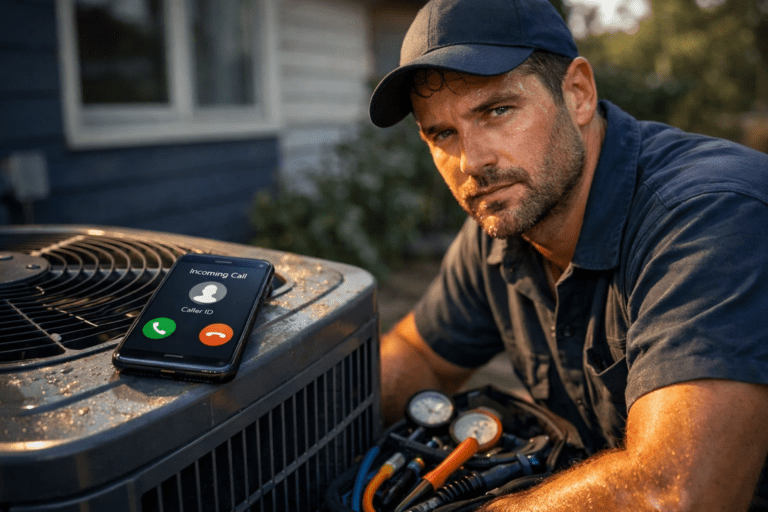
You’re on a roof in July, three hours into a tear-off, when your phone buzzes for the fifth time. You can’t answer. By the time you climb down at lunch, you’ve got two voicemails—one from a guy with a leaking water heater who says he’ll “try someone else,” and another from a property manager with a four-unit job who didn’t leave a callback number.
That’s easily a thousand dollars gone before you even knew it existed.
Every trades shop with more work than they can handle faces the same problem: you can’t be on the tools and on the phone at the same time. Miss the call, lose the job. It’s that simple. So the question becomes: how do you make sure every call gets answered without blowing your margins or your sanity?
For most small shops, that means choosing between two options—hire someone to handle your phones, or bring in an AI receptionist built for contractors. Let’s break down what each one actually costs, what you get, and which one makes sense when you’re running a tight operation.
What It Really Costs to Hire a Dispatcher
Hiring a person to answer your phones sounds straightforward until you start doing the math. A part-time dispatcher working 9-to-5 weekdays might run you $15 to $20 an hour depending on your market. That’s $600 to $800 a week, or roughly $2,400 to $3,200 a month—before you factor in payroll taxes, workers’ comp, or the time you’ll spend training them on how your business actually works.
And here’s the thing: most small shops don’t need someone full-time. You need someone who can pick up when you’re under a sink, when you’re driving between jobs, and when a furnace goes out at 9 p.m. on a Tuesday. A daytime dispatcher solves part of the problem, but you’re still losing after-hours calls unless you’re paying for coverage around the clock—which most one- to five-truck shops simply can’t justify.
Then there’s the reality of managing an employee. They get sick. They take vacation. They quit right before your busy season. And if they don’t know the difference between an emergency service call and a guy who wants a quote to maybe replace his AC next spring, you’re going to spend half your day cleaning up the schedule.
A good dispatcher is worth their weight in gold. But for a small shop that just needs the phone answered reliably without adding another salary to the books, it’s often overkill.
What an AI Receptionist for Contractors Actually Does
An AI receptionist built specifically for trades businesses does one job: make sure no call goes unanswered, and no lead falls through the cracks. But not all AI systems are created equal. Generic answering services don’t understand your business. They can’t tell a leaking pipe from a maintenance call, and they sure as hell can’t book your calendar or route an emergency to you at midnight.
That’s where purpose-built tools make the difference. Wrenchy, for example, is trained to handle calls the way a sharp front-desk person would—without the salary, the schedule, or the sick days. He picks up every call, qualifies the lead by asking the right questions, books jobs directly into your calendar, and knows when to flag something as urgent and get you on the line fast.
He works 24/7. He doesn’t take lunch breaks. And he doesn’t care if it’s Christmas morning—if someone calls with a burst pipe, he’s answering and making sure you know about it in real time.
More importantly, he sounds natural. Callers aren’t talking to a robotic menu system or leaving voicemails into the void. They’re having a real conversation with someone who understands what they need, collects the details, and gets them onto your schedule or into your pipeline without you lifting a finger.
The Cost Difference Is Hard to Ignore
A part-time dispatcher costs you a couple thousand dollars a month and covers maybe 40 hours a week. An AI receptionist for contractors runs a fraction of that—often under $500 a month—and works every single hour of every single day. No payroll taxes. No training time. No worries about coverage when someone calls in sick.
For a small shop, that difference adds up fast. You’re not just saving money—you’re capturing revenue you would have missed entirely. Every after-hours call that gets answered and booked is a job you wouldn’t have landed otherwise. Every lead that gets qualified while you’re finishing up a job is time you’re not spending playing phone tag at the end of the day.
When Hiring a Person Still Makes Sense
Let’s be clear: there are times when hiring a dispatcher is absolutely the right move. If you’re running eight trucks, juggling multiple crews, and coordinating complex commercial projects, you need a human being who can make judgment calls, manage schedules on the fly, and handle the kind of nuance that no software can touch.
If you’ve got the volume and the margin to support a full-time employee, and you need someone who can do more than just answer phones—dispatch drivers, order parts, follow up with customers—then hire that person. A great dispatcher is a force multiplier for a busy shop.
But if you’re a smaller operation, or you’re somewhere in that awkward middle zone where you’re too busy to answer every call yourself but not busy enough to justify a full-time salary, an AI receptionist is the smarter play. It gives you the coverage you need without the overhead, and it scales with you as you grow.
Stop Losing Jobs After Hours
Here’s what it comes down to: every missed call is a missed opportunity. You can’t answer the phone when you’re pulling wire, turning wrenches, or tearing off shingles. And you can’t afford to hire someone just to make sure your phone gets picked up.
An AI receptionist for contractors solves that problem without adding to your payroll. It’s not about replacing people—it’s about making sure your business doesn’t lose money because you’re too busy doing the work to answer the phone. You get 24/7 coverage, qualified leads, and a system that works with you, not against you.
For most small shops, that’s not just the smarter option. It’s the only option that actually makes sense.
Put Wrenchy to Work in Your Shop
If you’re tired of missing calls and losing jobs because you can’t answer the phone while you’re on site, it’s time to let Wrenchy handle it. WrenchBot AI gives you a 14-day free trial—no credit card required—and your shop can be live within 24 hours. Wrenchy answers every call, qualifies every lead, books jobs into your calendar, and notifies you in real time when something needs your attention. He works around the clock so you don’t have to. Stop leaving money on the table. Put Wrenchy to work and start capturing every opportunity that comes through your phone line.